Laugh Lab: The Nerdy Science of Engineering a Pun That Actually Goes Viral
For most of human history, a pun was either funny or it wasn't — and if your uncle's joke bombed at Thanksgiving, that was just the universe restoring balance. But a quiet revolution is happening in some very unexpected places: university linguistics departments, comedy writers' rooms, and surprisingly well-lit home offices where content creators are running spreadsheets on their own jokes.
Welcome to the golden age of pun science. Where every wordplay attempt is a hypothesis, every audience is a sample group, and the laugh track has been replaced by click-through rates.
The Lab Coat Meets the Punchline
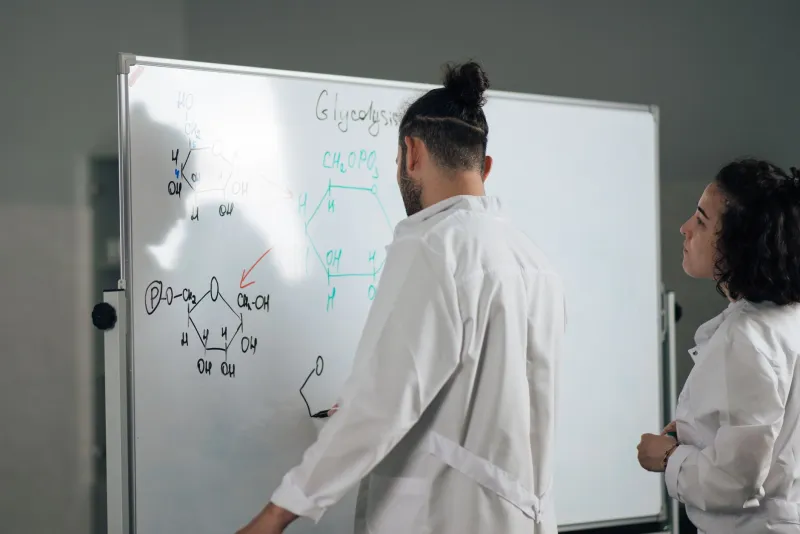
Dr. Amanda Forsythe — a computational linguist at a mid-sized research university in Ohio who moonlights as a comedy consultant — didn't set out to become the patron saint of pun optimization. She just noticed something odd while studying phonological ambiguity: the puns that spread fastest on social media weren't necessarily the cleverest ones. They were the ones that occupied a very specific cognitive sweet spot.
"There's a measurable delay between when someone hears a pun and when they react," she explained during a recent Zoom call, surrounded by whiteboards covered in what looked like ransom notes written by a thesaurus. "We call it the 'groan gap.' The longer the gap, the more viral the content tends to be. People need just enough time to feel clever for getting it — but not so much time that they feel stupid for not getting it sooner."
This groan gap theory has become something of a north star for a new generation of comedy writers who are blending creative instinct with hard data. And the results are genuinely fascinating — and a little bit terrifying if you prefer to believe humor is purely soulful and spontaneous.
Comedy Writers Who've Gone Full Data Nerd
Marcus Bell, a Los Angeles-based comedy writer with credits on several streaming sketch shows, started tracking audience responses to his puns about three years ago after noticing dramatic performance differences between nearly identical jokes.
"I had two bits about bread," he said, laughing at himself. "One killed every time. One died like it had a gluten allergy. The only real difference was the setup length and the specific homophone I chose. That broke my brain a little."
Bell now maintains what he calls a "pun ledger" — a running document cataloging every wordplay attempt he's made, the context it was deployed in, the audience demographic, and the response it generated. He cross-references this against trending language data and social listening tools to predict which phonetic combinations are primed to resonate in a given cultural moment.
"Right now, anything touching tech vocabulary is gold," he noted. "People are so saturated with jargon that when you flip it into wordplay, there's this instant release of tension. It's like popping bubble wrap, but for your brain."
The Phonetics of Funny
Not all puns are created equal from a pure sound-science perspective, and linguists have been saying so for decades. But the comedy world is only now catching up to what the academics have known all along: certain consonant clusters and vowel sounds trigger faster cognitive processing, which translates directly to quicker — and bigger — laughs.
Plosive sounds (think B, P, D, K) have long been considered inherently funnier than fricatives (F, V, S), a phenomenon comedians have exploited intuitively for generations. The word "pickle" is funnier than "salad." "Bucket" beats "vessel." "Kumquat" wins everything.
But the pun scientists are going deeper. They're mapping not just individual sounds but the architecture of the entire joke — the ratio of setup to payoff, the number of syllables before the pivot word, even the punctuation rhythm when the pun is written rather than spoken.
"Written puns are their own subspecialty," said Forsythe. "On platforms like X or Instagram, you have milliseconds to create that moment of delayed recognition. The line breaks, the capitalization — all of it is doing invisible work."
Testing Before Posting: The New Comedy Workflow
For content creators operating in the pun space, audience testing has moved from luxury to necessity. Several mid-level comedy accounts on Instagram and TikTok now use small focus panels — often just tight Discord communities of trusted followers — to stress-test wordplay before pushing it to their main audience.
Creator Jamie Osei, who runs a wordplay-focused Instagram account with just under 400,000 followers, described her process as "comedy quality control with a side of existential dread."
"I'll post a pun to my close friends story first," she said. "I watch the reaction speed. If the laughing emojis come in fast, it's a banger. If I get a lot of 'lol' with no emoji — that's the kiss of death. 'Lol' means they acknowledged the joke but didn't actually laugh. It's the comedy equivalent of a participation trophy."
Osei has also experimented with two-version testing — releasing slightly different phrasings of the same core pun to different audience segments and measuring engagement. The differences can be staggering. A single word swap once produced a 34% difference in share rate.
Why This All Matters (And Why It's Also Kind of Hilarious)
There's a delicious irony baked into all of this. Puns — historically dismissed as the lowest form of humor, the groan-inducing province of dad jokes and cereal box copy — are now being subjected to the same rigorous optimization frameworks that billion-dollar advertising campaigns use. The joke format that everyone loves to hate has become serious business.
But the pun scientists themselves are quick to push back against the idea that data kills the magic. If anything, they argue, understanding the mechanics of why something is funny makes it more miraculous, not less.
"Knowing why a sunset is beautiful doesn't make it less beautiful," Forsythe said. "Knowing why a pun lands — the phonetics, the timing, the cognitive release — doesn't make the laugh less real. You still laughed. That still happened."
Marcus Bell put it more simply: "I'm not building robots. I'm just trying to make sure my bread puns don't die in vain."
At PunGalaxy, we'll drink to that — or at least groan in solidarity. After all, if science can give us better puns, maybe the universe isn't so chaotic after all. Or maybe it's just punning us along.